How to Choose a Restoration Water Damage Services Provider After a Pipe Burst
A pipe bursts at 2 a.m. By morning, standing water covers your basement floor and the drywall is already pulling moisture from the bottom up.
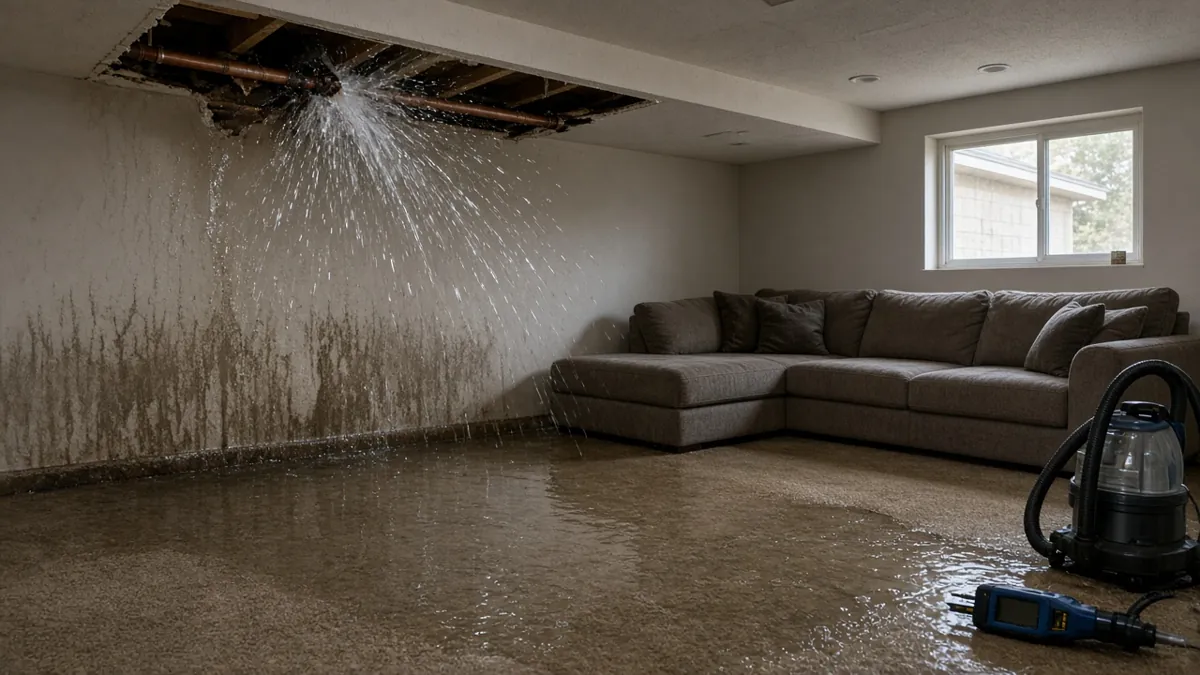
A pipe bursts at 2 a.m. By morning, standing water covers your basement floor and the drywall is already pulling moisture from the bottom up. At Guardian Restoration, we frequently receive calls like this across Utah County, Salt Lake County and Northern Utah, and the homeowners who fare best are the ones who act within the first hour. This guide gives you a clear framework for choosing restoration water damage services: what to do before the crew arrives, what the full restoration process actually looks like, how to vet a company fast, and what to expect from your insurance claim.
Why pipe bursts cause more damage than most homeowners expect
Pipe failures in Utah rarely come out of nowhere. The most common culprits are frozen supply lines in exterior walls and unheated crawl spaces, aging galvanized pipes that have thinned from years of hard-water mineral buildup, pressure spikes from sudden temperature swings, and failed appliance supply lines behind washers or refrigerators. Utah, Salt Lake, Davis and Weber counties sit in a freeze-thaw pattern every winter: temperatures drop overnight, warm during the day, and repeat. That cycle stresses pipes repeatedly until one gives.
The damage compounds fast once water is moving. Within minutes, water absorbs into drywall, insulation, and subfloor materials. Within 24 to 48 hours, moisture levels in those materials reach the threshold where mold colonies establish. What starts as a clean-water loss from a burst supply line can become a mold and structural problem if extraction is delayed even by a day. That is why Guardian provides an on-site inspection within 45 minutes: the first hour is when the scope of damage is still manageable.
What to do before the restoration crew arrives
The first action is non-negotiable: shut off the main water supply valve. Nothing else matters until the source is stopped. If the shutoff is inaccessible or unclear, call your utility provider immediately rather than risk additional flooding. Once water is no longer flowing, do not enter any room with ceiling bulges, visible structural damage, or standing water near electrical panels and outlets. Turn off electricity at the breaker for any affected zone before walking through it.
While you wait for the crew, document everything. Walk every affected area with your phone and shoot video before moving a single piece of furniture or mopping up standing water. This documentation is your insurance claim foundation. Adjusters need to see the full scope before cleanup begins, so photograph all damaged materials before discarding anything.
Call your insurance carrier right away to report the loss and follow their guidance. Most policies require prompt notification, and delays can create coverage complications later. Many carriers expect you to take reasonable emergency steps to prevent further damage, so do not hold off on critical mitigation while you wait for a callback.
What the full water damage restoration process actually looks like
Here is how professional water damage restoration services in Utah typically unfold, from first arrival to final verification.
Moisture mapping
When a qualified crew arrives, the first task is moisture mapping, not just a visual scan. Technicians use calibrated moisture meters and thermal imaging to identify water that has migrated into wall cavities, beneath flooring, and into subfloor assemblies. Hidden moisture commonly exists well beneath the surface. Areas that look dry to the touch can be saturated underneath. That initial moisture map sets the drying targets the crew will measure against every single day.
Emergency water extraction
Emergency water extraction follows, using professional extractors and industrial wet vacuums. The goal is removing bulk water within the first 24 hours. Saturated materials that cannot dry in place, including carpet pad, compromised insulation, and heavily soaked drywall, are removed at this stage rather than left to create mold conditions underneath the equipment.
Drying and dehumidification
After extraction, industrial air movers and dehumidifiers go in. This is not just fans blowing; equipment is placed strategically based on the moisture map, and technicians return daily to log temperature, humidity, and moisture readings and reposition units when drying stalls. A typical clean-water loss in a single area dries in three to five days, though timelines vary by severity and affected materials. Saturated subfloors, particularly concrete slabs that held standing water for eight or more hours, can take seven to fourteen days or longer. Equipment should not come out until materials reach documented dry-standard benchmarks, not just when surfaces feel dry to the touch.
Mold prevention
Mold prevention is built into the drying process, not added at the end. If mold is already present when the crew arrives, mold remediation after water damage requires containment and HEPA filtration before any reconstruction begins. Final repairs, including drywall replacement, flooring, and painting, start only after drying verification is complete and documented in writing.
How to evaluate and compare restoration water damage services quickly
When you vet a company, start with the IICRC. The key credential to verify is the IICRC WRT (Water Damage Restoration Technician) certification: it covers extraction, drying science, moisture documentation, and equipment use. Ask which technicians on your job hold it. The IICRC also offers more advanced training, such as ASD (Applied Structural Drying) for complex assemblies like subfloors, wall cavities, and hardwood. Beyond technician certification, confirm the company holds a Utah contractor license, and before anyone sets foot on your property, require proof of general liability insurance and workers' compensation.
Several red flags tell you to stop the conversation and call someone else:
- No verifiable IICRC-certified technicians or state contractor license number
- Verbal estimates with no written scope before work begins
- Pressure to sign an Assignment of Benefits (AOB) without a clear explanation of what rights you are transferring
- Unmarked vehicles, no local address, and an unsolicited arrival right after a storm
- Promises about what your insurance will cover
Before signing anything, ask these questions directly: "What is your state contractor license number?" "Which technicians on my job hold current WRT certifications?" "Will you follow IICRC S500 drying procedures and provide me with daily drying logs?" "Do you handle direct insurance billing, and what is my financial responsibility if the claim is reduced?" "Who is my single point of contact from start to finish?" A company that cannot answer those questions clearly is not ready to work on your home.
How insurance documentation and direct billing actually work
Your insurance adjuster needs specific documentation to process a water damage claim efficiently. That means time-stamped photos and videos taken before and during cleanup, daily drying logs with moisture readings and equipment placement records, and a detailed line-item scope covering labor, materials, and equipment quantities. If hidden damage is discovered mid-project, that requires a written change order and a supplemental estimate, not a verbal conversation. The quality of this documentation package directly determines how smoothly the claim moves through the approval process.
Direct billing means the restoration company submits the invoice to your insurer. It does not mean you owe nothing. You are still responsible for your deductible, any non-covered work, policy-limit overages, and amounts the insurer declines. The AOB form that many companies ask you to sign can give the company significant rights over claim proceeds. Utah law sets rules for these forms, so read it carefully, confirm it itemizes the specific work, and clarify in writing who is responsible for payment if the claim is denied or underpaid. For a large loss, having a Utah insurance attorney review the form before signing is worth the time.
On cost: every job is priced on its own scope. The biggest drivers are the water category (clean water from a supply line costs less to mitigate than sewage or contaminated water), the square footage affected, the materials involved (carpet and pad, drywall, hardwood, cabinetry, subfloors), and how long drying takes. Reconstruction is billed separately from mitigation and can add substantially to the total, particularly if subfloors, framing, or finished cabinetry are involved. Getting documentation started immediately keeps the scope from expanding beyond what it needs to be.
How Guardian Restoration handles a call and what that means for you
In one recent job, a homeowner called Guardian Restoration for water damage restoration in Murray after a washing machine supply line failed overnight. Water had spread across a large portion of the finished basement by morning, soaking carpet, pad, and the lower sections of drywall throughout the affected rooms. A Guardian specialist arrived within 45 minutes for a free inspection, completed moisture mapping before any extraction began, and provided a clear scope and timeline before a single piece of equipment was placed. No surprises, no pressure to sign anything without reading it first.
At Guardian, that same specialist managed the project from the first call through the final moisture verification. No handoffs, no retelling the story to different crew members, no wondering who to call when a question came up on day three. Drying was complete in five days. Guardian handled direct billing with the homeowner's carrier and delivered the full documentation package the adjuster needed without the homeowner having to chase anything down.
Some restoration companies rotate crew without a consistent point of contact. The homeowner ends up explaining the situation repeatedly to different people, and accountability gets diffuse. One specialist owning a project from start to finish means faster decisions, clearer communication, and a single person responsible for the outcome. At Guardian, that structure is not a marketing promise; it is a workflow choice that changes how the project actually runs.
Based in American Fork, Guardian Restoration provides water damage repair and cleanup services to homeowners across Utah, Salt Lake, Davis, Weber, Summit and Wasatch counties with around-the-clock emergency response, from water damage restoration in American Fork and water damage restoration in Salt Lake City to water damage restoration in Bountiful and water damage restoration in Ogden. If you have had a pipe burst, appliance leak, or basement flood, call for a free inspection. There is no obligation to commit before you know the full picture of what you are dealing with.
Making the right call fast
When you need water damage restoration services after a pipe burst, speed and accountability matter most. Delays increase the risk of secondary damage and can complicate insurance claims. The longer water sits, the wider the scope grows. Verify that any company you call has IICRC-certified technicians, assigns a single project lead, and can be on-site fast. The free inspection removes the risk of committing before you understand what the work involves.
If you are anywhere across Utah County, Salt Lake County and Northern Utah and need water damage restoration services near you, Guardian Restoration is ready to respond around the clock. Call (385) 625-7333 now for a free inspection, and get a specialist on-site within 45 minutes to assess the damage and give you a clear path forward before any work begins.